
Computers and smartphones might be where most writing is done these days, but typewriters still have work to do in the US.
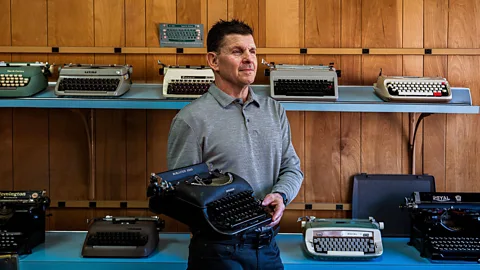
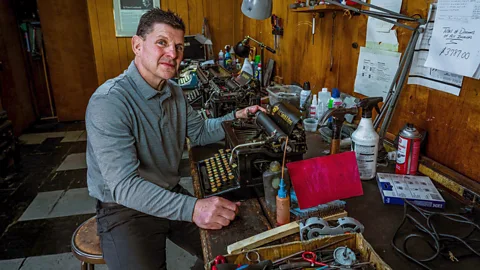
Pretty much every day, another customer clutching an old typewriter will walk into Mike Marr's shop in Pawtucket, Rhode Island. Marr carefully looks the machine over. Invariably, it will be a total mess. Made decades ago, the hunk of heavy metal bristling with moving parts is now laced with years of grime. The keys are too stiff. Or maybe the paper that's supposed to glide through it keeps getting stuck.
"Do you think you can get it going again?" the customer will ask, a touch of anxiety in their voice. Marr, who has been repairing typewriters for more than 20 years, will say he'll give it his best shot.
"When they come in and pick that typewriter up, just seeing their smile is everything to us," he says. Even in the year 2025, a century and a half after the first commercially successful typewriter was introduced to the American public, surprising numbers of people in the US are still using these machines. And not just for fun – many of Marr's customers are businesses. "We're still servicing probably 20 to 25 typewriters a week," he says. He employs three other people in his shop to keep up with the demand. "Isn't that crazy?"
In today's world, internet-connected computers and smartphones are king. They're used for the vast majority of business tasks and transactions. But here and there, in little offices and warehouses, you can still find a well-worn typewriter lingering in the corner. A machine whose keys have been pressed many thousands, if not millions, of times. To this day, typewriters print names on forms. They put addresses on envelopes. They fill out cheques. And the people who use them, generally speaking, have no intention of switching to a computer any time soon – at least for those particular tasks.
 Ernesto Roman
Marr Office Equipment's heyday may be long gone but Marr still knows typewriter users all over his local area. He mentions one that is about a 10 minute drive away, in south Providence – a law firm named Tomasso & Tomasso, co-owned by brothers John and Ray, both attorneys. "We sound exactly alike," says John, laughing as he introduces himself over the phone. Do they actually still rely on typewriters? Absolutely. "There's not a day that goes by that we don't use them," says Tomasso. "This is really still the best way."
The firm's office has three typewriters, John says and his colleagues still use them to type up cheques and fill in legal forms to ensure the details on those documents are legible. Plus, there's a security angle. It's very hard to hack a typewriter since they are not connected to the internet. In 2013, jaw-dropping details emerged about the extent of US intelligence agency surveillance programmes. This prompted the Russian Federal Guard Service (FSO) to revert to typewriters in an attempt to evade eavesdropping. German officials were also reported to be considering a similar move in 2014. (During the Cold War, Soviet spies actually developed techniques for snooping on electric typewriter activity, a form of "keylogging" technology – where the keystrokes inputted on a keyboard are captured. US operatives also reconstructed text from typewriter ribbons – meaning that even typewriters aren't completely safe.)
I ask Tomasso whether there are downsides to using the typewriter – isn't it harder to correct mistakes? No, he replies, he has a model with an "eraser ribbon" that seamlessly covers up a mistype. Plus, the typewriters are inexpensive to run. Replacement ink ribbons cost around $5 (£4), he estimates. Replacement printer ink cartridges can cost several times that.
Besides, Tomasso loves to see his writing materialise instantly on the page in front of him. "There's more of a sense of accomplishment than just letters that appear on a screen," he explains. "It's one of those amazing devices that just makes our life better – I think that's the purpose of technology."
Further west, in Milwaukee, Wisconsin, is a real estate agency called Jarvis Realty, owned and run by Woody Jarvis. "I'm real old school," he says. Jarvis, too, regularly uses a typewriter for office work. He gives the example of putting together an offer of purchase for a client. It'll start on the computer but he'll then print the document out and, should he need to make any modifications, he prefers to use correction fluid and his typewriter rather than re-printing the contract and wasting a lot of paper. "Our contracts are very legible and easy to understand," he says. He'll also occasionally type up a name and address on an envelope for a colleague. "For me, it works because I know how to make it all work."
Typewriters have had a long and colourful history. Centuries ago, tinkerers came up with early, experimental typing machines but they didn't really catch on. Then, in 1868, the first device actually called a typewriter emerged: the Sholes and Glidden Type-Writer, which was patented that year by four inventors in Milwaukee. One of the group, Christopher Latham Sholes, also invented the Qwerty keyboard. Without him, typing – even on computers – might be very different today. By the 20th Century, typewriters were everywhere. Millions of the machines were sold in the first few decades of the 1900s and by the mid-1980s, the typewriter industry was worth more than $1.1bn (£764m) in the US alone, according to press reports from the time.
In the 21st Century, typewriters have remained popular in certain corners of the world, despite the rise of computers. In India, for example, typewriters have found a flourishing market among enthusiasts and are still a common – albeit steadily vanishing – sight in courts and government offices.


0 Comments