
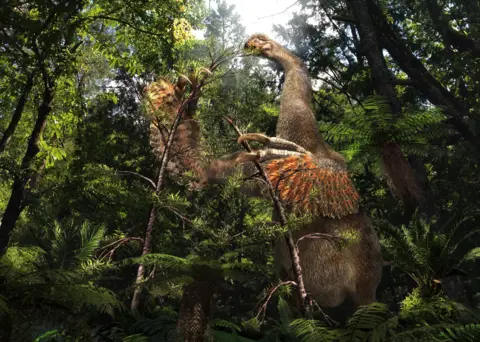
 Artist's impression by Masato Hattori
A rare new species of two-clawed dinosaur has been discovered by scientists in Mongolia's Gobi Desert.
The species, named Duonychus tsogtbaatari, was unique within a group of dinosaurs called Therizinosaurs, which stood on their hind legs and usually had three claws.
It was medium-sized, with an estimated weight of approximately 260kg.
Researchers believe the species' long, curved claws and its ability to strongly flex them would have made it an efficient grasper of vegetatio
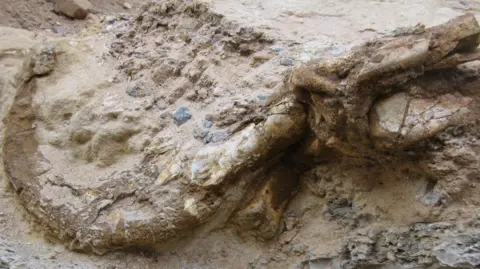 Yoshi Kobayashi, Hokkaido University
Therizinosaurs were a group of either herbivorous or omnivorous theropod dinosaurs that lived in Asia and North America during the Cretaceous Period, which began 145 million years ago and ended 66 million years ago.
They are exemplified by the massive, long-clawed form Therizinosaurus, featured in the film Jurassic World Dominion, and were "awkward looking", according to one of the study's authors Dr Darla Zelenitsky, associate professor at the University of Calgary.
The specimen was recovered from the Bayanshiree formation in the Gobi Desert of Mongolia, which dates back to the Late Cretaceous period (between 100.5 to 66 million years ago).
Unesco, the UN's Educational, Scientific and Cultural Organization, calls the Mongolian Gobi Desert the largest dinosaur fossil reservoir in the world.
The region is an especially important source of fossils from the later Cretaceous period, which is the last of the main three periods of the dinosaur age, representing the final phase of dinosaur evolution.


0 Comments