
 Cambridge University Library
An intriguing sequel to the tale of Merlin has sat unseen within the bindings of an Elizabethan deeds register for nearly 400 years. Researchers have finally been able to reveal it with cutting-edge techniques.
It is the only surviving fragment of a lost medieval manuscript telling the tale of Merlin and the early heroic years of King Arthur's court.
In it, the magician becomes a blind harpist who later vanishes into thin air. He will then reappear as a balding child who issues edicts to King Arthur wearing no underwear.
The shape-shifting Merlin – whose powers apparently stem from being the son of a woman impregnated by the devil – asks to bear Arthur's standard (a flag bearing his coat of arms) on the battlefield. The king agrees – a good decision it turns out – for Merlin is destined to turn up with a handy secret weapon: a magic, fire-breathing dragon.
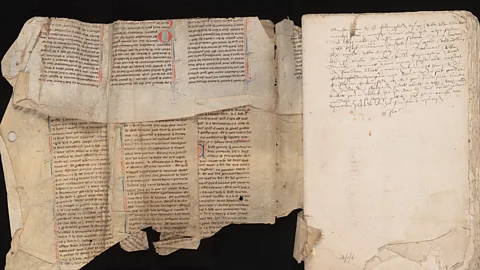
For over 400 years, this fragile remnant of a celebrated medieval story lay undisturbed and unnoticed, repurposed as a book cover by Elizabethans to help protect an archival register of property deeds
Now, the 700-year-old fragment of Suite Vulgate du Merlin – an Old French manuscript so rare there are less than 40 surviving copies in the world – has been discovered by an archivist in Cambridge University Library, folded and stitched into the binding of the 16th-Century register.
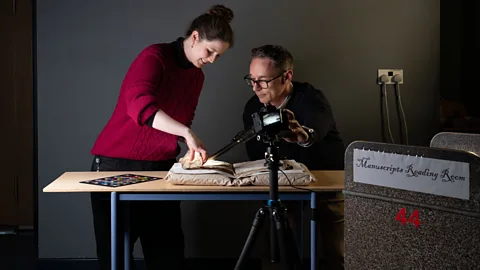
Using groundbreaking new technology, researchers at the library were able to digitally capture the most inaccessible parts of the fragile parchment without unfolding or unstitching it. This preserved the manuscript in situ and avoided irreparable damage – while simultaneously allowing the heavily faded fragment to be virtually unfolded, digitally enhanced and read for the first time in centuries.
Previously, it was catalogued as the story of Gawain. "It wasn't properly inventoried," says Irene Fabry-Tehranchi, the French specialist at the library. "No one had even recorded that it was in French."
 Cambridge University Library
When she and her colleagues realised the fragment told a story about Merlin and his ability to change shape "we were really excited," she say
The Suite Vulgate du Merlin was originally written around 1230, a time when Arthurian romances were particularly popular among noblewomen, although the fragment is from a lost copy dated to around 1300. "We don't know who wrote the text," says Fabry-Tehranchi. "We think it was probably a collaborative exercise."
It is positioned as a sequel to an earlier text, written around 1200, in which Merlin is born a child prodigy gifted with foresight and casts a spell to facilitate the birth of King Arthur, who proves his divine right to rule by pulling the sword from the stone.
"The Suite Vulgate du Merlin tells us about Arthur's early reign, his relationship with the knights of the round table and his heroic fight with the Saxons. It really shows Arthur in a positive light – he's this young hero who marries Guinevere, invents the Round Table and has a good relationship with Merlin, his advisor," says Fabry-Tehranchi.


0 Comments